
You've spotted the perfect car at CHF 35,000. Or maybe an apartment at CHF 650,000. One essential question remains: will the bank go along with it? The answer depends on a single number that many borrowers discover too late — their borrowing capacity.
What borrowing capacity tells you (and doesn't tell you) about your budget
Your borrowing capacity is the maximum amount a financial institution will agree to lend you. It's based on your income, fixed expenses, and the loan's interest rate.
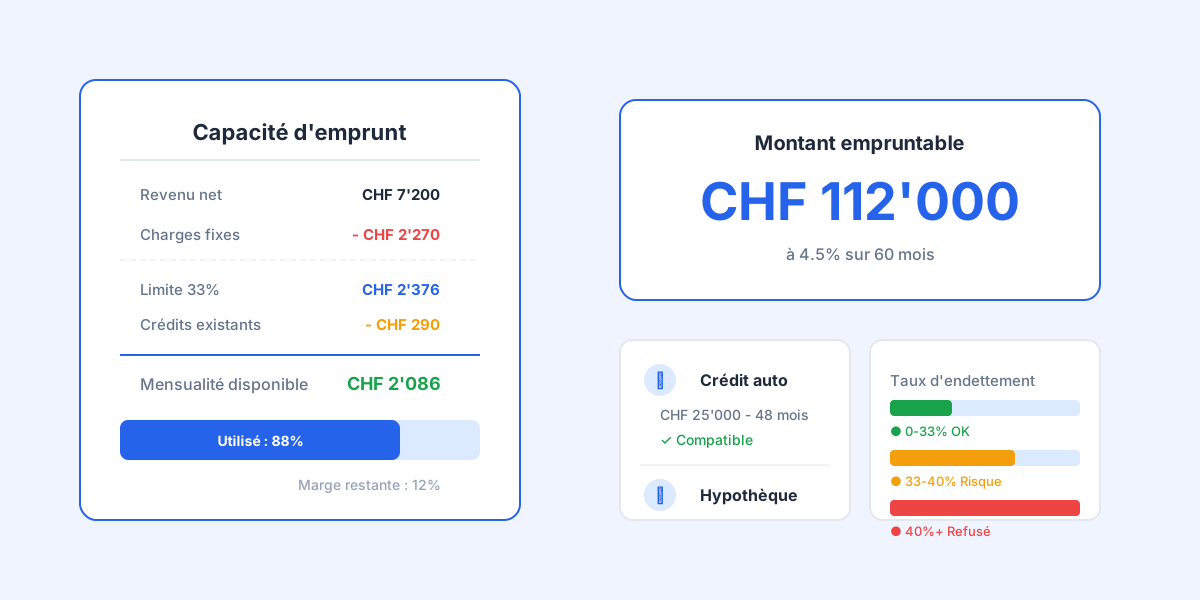
Let's take a concrete case. Marc earns CHF 7,200 net per month. His rent is CHF 1,600, health insurance CHF 380, and he's already repaying a car lease of CHF 290 per month. His total fixed monthly charges come to CHF 2,270.
Applying the one-third rule — a maximum of 33% of net income in repayment charges — Marc can allocate CHF 2,376 per month to his loans (CHF 7,200 x 0.33). But he needs to subtract his existing lease of CHF 290. That leaves CHF 2,086 in available monthly payment for a new loan.
At a rate of 4.5% over 60 months, this payment gives him access to roughly CHF 112,000 in borrowing. Not bad. But if Marc wanted to borrow CHF 150,000, he'd need to extend the term or reduce his existing fixed charges.
This borrowing capacity calculation is a starting point, not an absolute ceiling. The bank will also consider your job stability, credit history, and down payment.
"I earn a good salary, so I can borrow a lot" — not so fast
This is the most common misconception. A high income doesn't guarantee high borrowing capacity. What matters is your available income, after all expenses.
Sophie earns CHF 9,500 net. Impressive on paper. But between her mortgage of CHF 2,100, apartment charges, two insurance policies, childcare costs, and a small outstanding loan, her fixed charges reach CHF 5,800. Her margin for a new loan? Barely CHF 1,335 per month.
On the other hand, Thomas earns CHF 6,000 net with CHF 2,400 in fixed charges. His available margin is CHF 1,580 — higher than Sophie's despite a lower salary.
The debt-to-income ratio is the real indicator. It's the ratio between your loan payments and your net income. Beyond 33%, most Swiss banks hit the brakes. Beyond 40%, doors close. And it's not about bureaucracy: excessive debt puts your financial balance at risk at the slightest unexpected expense.
Four steps to calculate your borrowing capacity
List your net monthly income. Salary, regular supplementary income, pensions — add up everything that comes in reliably each month. Exclude one-time bonuses and variable income that isn't guaranteed.
Add up your fixed charges. Rent or mortgage, health insurance, monthly taxes, current loans, leasing, alimony. Be honest — forgetting a charge throws off the entire calculation.
Apply the 33% rule. Multiply your net income by 0.33. Subtract your existing loan payments. The result is the maximum monthly payment you can dedicate to a new loan.
Convert to a borrowable amount. This is where it gets tricky, because the amount depends on the rate and term. A loan simulator does this calculation in seconds. By hand, you'd need to wrestle with annuity formulas that nobody wants to work through on a Sunday evening.
How much to borrow for a car loan vs. a mortgage?
Borrowing capacity doesn't work the same way depending on the type of loan.
For a personal or car loan, terms range from 12 to 84 months and rates oscillate between 3.9% and 7.9% in Switzerland. On a CHF 25,000 car loan at 4.9% over 48 months, the monthly payment is CHF 575. If your margin allows it, this loan goes through without a problem.
For a mortgage, the rules are different. Swiss banks generally require a minimum 20% down payment. For a CHF 800,000 property, you need CHF 160,000 in equity. Then, the total charge — interest, amortization, and maintenance costs — must not exceed one-third of your gross income. With a calculated rate of 5% (the theoretical rate used by banks), a minimum gross annual income of CHF 165,000 is needed for this property.
The gap is enormous. That's why simulating each type of loan separately is essential. The parameters change, and your borrowing capacity changes with them.
Run the numbers in two minutes
Rather than pulling out a calculator and searching for formulas, test your borrowing capacity directly on Crezio. Our free simulator instantly shows you how much you can borrow based on your situation. Adjust the amount, term, and rate to see the impact on your monthly payments — whether it's for a mortgage, a car loan, or a personal loan. Five minutes of simulation can save you months of regret.
Meta description: Calculate your borrowing capacity in Switzerland: simple method, concrete examples, and a free simulator to find out how much you can borrow.
Suggested internal link: Simulate a personal loan in Geneva