
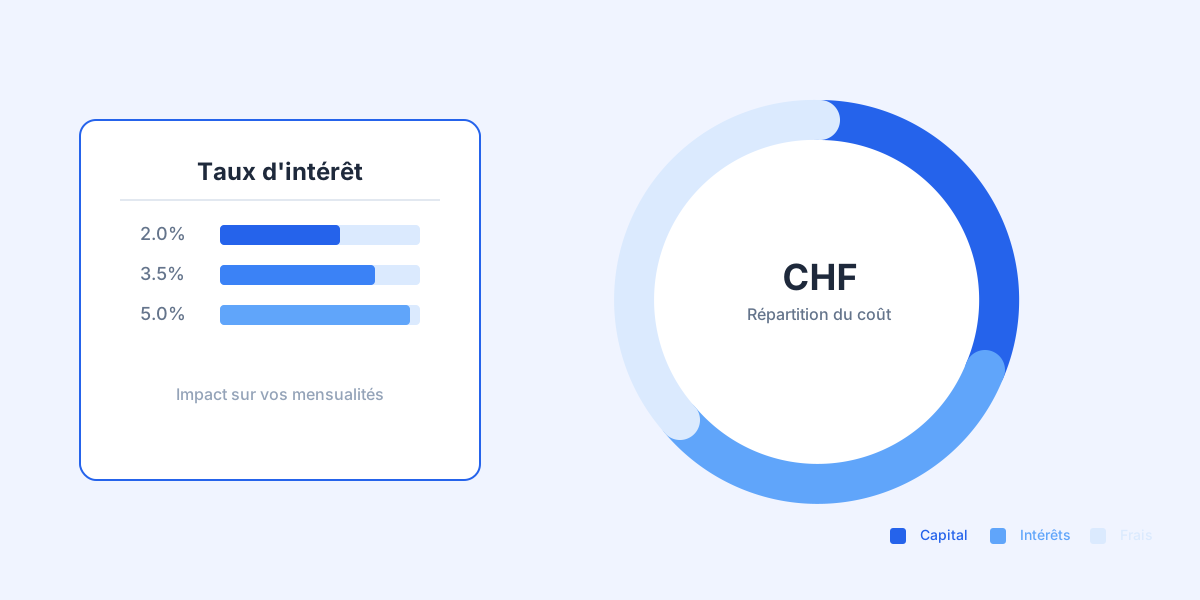
You sign a CHF 200,000 loan over 20 years. The bank quotes you 3.5%. Sounds reasonable, right? Except that small percentage difference compared to 2% will cost you CHF 34,000 more in total. Welcome to the world of interest rates.
The interest rate is the price of borrowed money
When you borrow money, the bank charges you rent for that money. That's the interest rate, expressed as an annual percentage of the borrowed amount.
Let's take a simple example. You borrow CHF 10,000 at 4.5% over 3 years. Each year, the bank charges interest on the remaining balance. The first year, that's roughly CHF 450. But since you're also repaying principal each month, the interest portion gradually decreases. In the end, your monthly payment comes to CHF 297 and you'll have paid CHF 693 in total interest over the 3 years.
This mechanism is called amortization. At the start of the loan, most of your monthly payment goes toward interest. Toward the end, it goes almost entirely to principal repayment. That's why early repayment at the beginning of a loan saves you far more than at the end.
Fixed rate or variable rate: which one to pick?
It's the question everyone asks. And the answer depends on your risk tolerance.
With a fixed rate, your monthly payment stays the same for the entire loan term. You know exactly how much you're paying each month, with no surprises. That's reassuring, especially for a mortgage over 15 or 20 years. The trade-off is that the starting rate is generally higher than a variable rate.
A variable rate moves with the market. If rates drop, you benefit directly. But if they rise, your payments increase. For a personal loan of CHF 15,000 over 36 months, a variable rate that jumps from 3.9% to 5.5% can add CHF 10 to 15 per month. Doesn't sound like much, but over the full term, it adds up.
In Switzerland, fixed rates remain the most common choice for mortgages. For short-term personal loans, a variable rate can be attractive if market conditions are favorable.
The mistake that costs thousands of francs
Most borrowers only look at the monthly payment. "CHF 450 a month — that fits my budget." But this reflex hides an important reality: the total cost of the loan.
Let's compare two scenarios for a CHF 30,000 car loan:
Scenario A: 3.9% rate over 48 months. Monthly payment of CHF 676. Total interest cost: CHF 2,448.
Scenario B: 5.9% rate over 60 months. Monthly payment of CHF 580. Total interest cost: CHF 4,800.
Scenario B looks more comfortable with a lower monthly payment. But you pay CHF 2,352 more in interest. Almost enough for a nice vacation. Extending the term to lower the monthly payment always costs more in the end.
Four habits that save you money on interest
Negotiate your rate. Posted rates are rarely the best available. If you have a solid profile — stable income, low debt, personal savings — you have room to negotiate. Even 0.3% less on a CHF 200,000 loan means thousands of francs saved.
Shorten the term when possible. A 36-month loan costs less than a 60-month loan, even if the monthly payment is higher. Find the right balance between what you can pay each month and the total cost.
Watch the APR. The Annual Percentage Rate includes processing fees, insurance, and other costs. It reflects the true price of the loan, not just the nominal rate.
Simulate before you sign. Testing different combinations of amounts, terms, and rates gives you a clear picture of what you'll actually pay. It's the best way to avoid unpleasant surprises.
Your rate, your money, your choice
The difference between a good and bad interest rate can represent thousands of francs over the life of a loan. Before committing, take five minutes to simulate your loan on Crezio. Our free calculator instantly shows you the impact of the rate on your monthly payments and total loan cost. You'll know exactly what to expect before you even walk into the bank.